Curious about what are the Best Materials for Bathroom Cabinets to Withstand Moisture? or which cabinet choices actually survive daily steam and splashes? At American Home, we see bathrooms act like moisture torture chambers for wood and finishes. That stress makes selecting the right cabinet material and sealed edges essential for long service life.
We’ll answer the core question: what materials are best for bathroom cabinets to withstand moisture, then explain how to balance performance, design, and budget. Our design staff brings 60+ years of combined experience guiding homeowners through real-world humidity challenges.
Expect a clear guide: engineered options, select solid wood, stainless steel, and waterproof synthetics. We’ll point out common weak spots — box joints, door edges, and finish gaps — and share finish and care tips that extend longevity.
Trust our team to recommend solutions that focus on durability, lasting quality, and finishes that protect your investment. Start by assessing humidity and direct-water zones; the right plan follows.
Key Takeaways
- Bathrooms put constant stress on cabinetry from steam and splashes.
- We recommend plywood, moisture-resistant MDF, select solid wood, stainless steel, and waterproof synthetics.
- Sealed edges and proper finishes are as important as the core material.
- Design, performance, and budget must be balanced for lasting results.
- Assess humidity and direct-water zones before choosing cabinet materials.
- Our expert team helps create a finish plan that boosts moisture resistance and quality.
Why bathroom cabinets fail in humid spaces
Steam and splashes turn many rooms into an unforgiving test for cabinetry. Repeated steam cycles and wet hands at the sink keep surfaces and seams under constant pressure. That steady exposure stresses finishes and core panels.
Humidity causes wood and engineered boards to expand and shrink. Those cycles make doors and drawers twist, bind, or develop uneven reveals. Over time, warped pieces no longer sit flush and cabinet operation suffers.
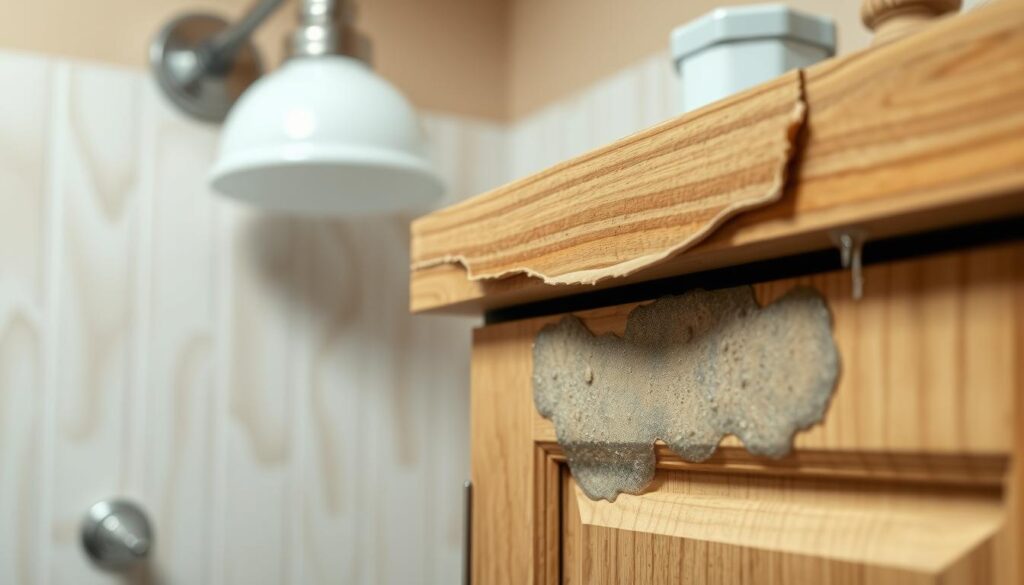
How moisture and water speed failure
Finish failure often begins as hairline cracks or peeling at corners. Once the protective layer breaks, moisture moves into joints and fastener points. Pooling water near plumbing accelerates swelling and structural damage.
Early warning signs and risk zones
Look for sticky doors, misaligned drawers, and gaps at corners. Joints and edges near sinks and tubs face the most mechanical stress, so they fail first.
- Repeated steam weakens finishes.
- Direct splashes penetrate edges faster.
- Poor cores swell and lose strength.
Choosing cheap options can mean replacing cabinets sooner. Preventing water damage is about matching performance to your room’s humidity, not just buying the lowest price.
What “moisture-resistant” really means for cabinet materials
Understanding true moisture resistance helps you spot construction details that actually hold up in humid rooms.
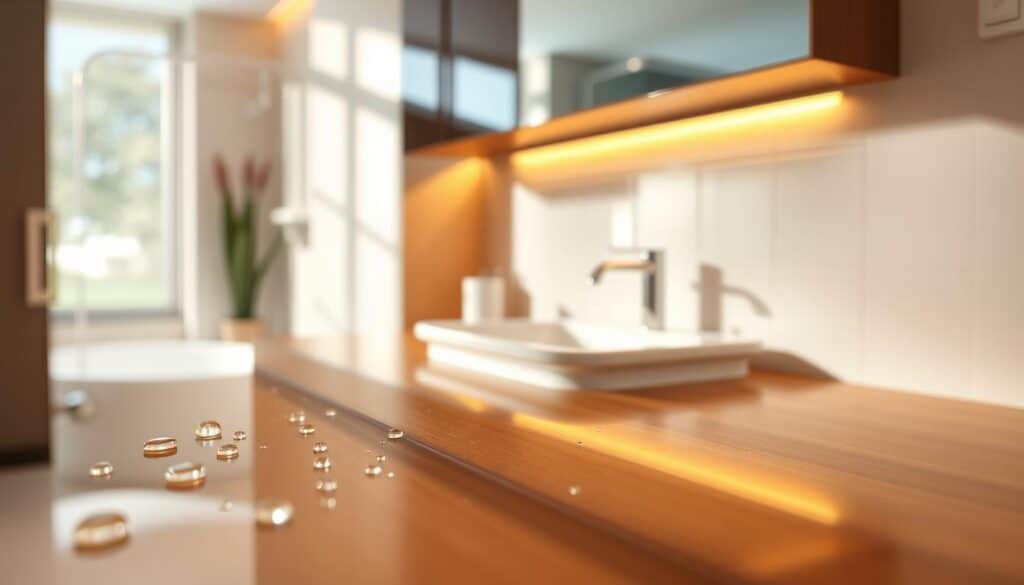
In plain terms, moisture resistance slows water absorption and limits short-term damage. Water resistance helps finishes shed steam and splashes. By contrast, waterproof performance needs non-porous surfaces or fully sealed construction to stop standing water.
Where moisture enters first
Seams, toe-kicks, hinge areas, sink cutouts, and the bottom edges of doors are the usual entry points. Small gaps let water reach the core quickly and start swelling or delaminating.
Why edges and banding matter
Edge banding and sealed cut edges are make-or-break for engineered cores. Unsealed edges let moisture in faster than a poor surface finish fails.
- Ask about edge sealing during selection: sealed cuts, end-grain protection, and wrapped banding.
- Protect cabinet doors with durable finishes; edges and handles take the most wear.
- Use layered finishes (primer, paint/topcoat, clear) to protect the surface and vulnerable seams.
Quick buyer’s guide: match cabinet material to your bathroom’s moisture level
Start by sizing up daily use, splash risk, and ventilation before choosing your cabinet core. A clear category helps narrow options fast: primary bath with daily showers, kids’ bath with frequent splashes, or a low-use powder room.
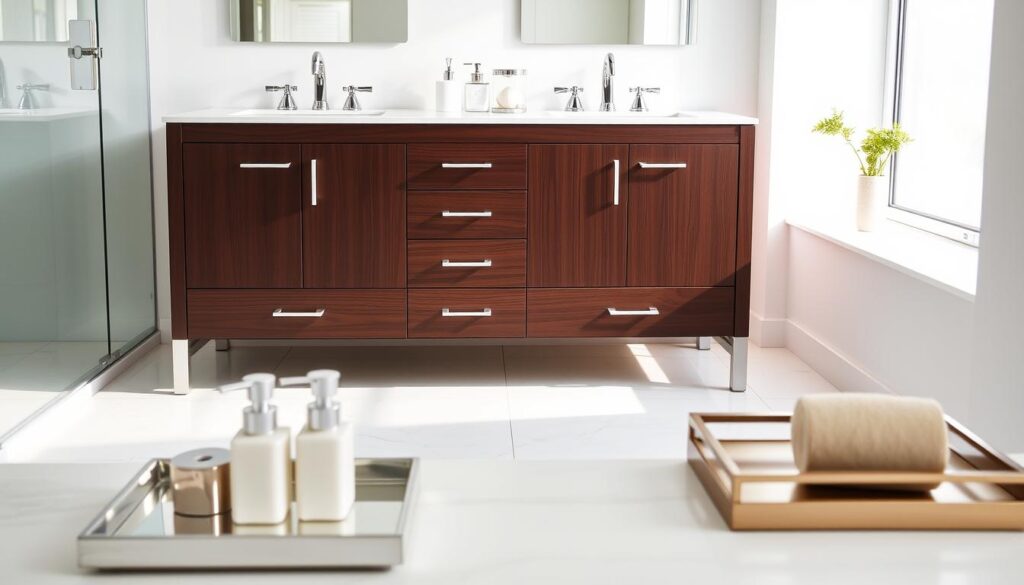
High-humidity primary baths vs low-use powder rooms
Primary suites that steam every day need robust, moisture-tolerant cores and sealed edges. We favor non-porous surfaces near frequent wet cycles.
Powder rooms can use a broader range of finishes since humidity and water contact are limited.
Direct water exposure zones around sinks, tubs, and showers
Identify splash zones: sink plumbing, countertop edges, and tub surrounds demand the toughest options.
Near plumbing or tubs, choose truly non-porous surfaces or fully sealed construction.
How ventilation changes your best material choice
Good ventilation raises the number of workable choices. A strong fan and habit of running it after showers reduce swelling risks.
Use this quick checklist to match selection with real-life use:
- How often is the room used? (daily vs occasional)
- Do mirrors fog for long periods after showers?
- Does water routinely sit on the vanity top or spill at edges?
- Is the fan run regularly or is there a usable window?
Bottom line: The best bathroom option depends on humidity frequency, direct splash zones, and ventilation. We’ll next list top-performing choices and why they earn that ranking.
What materials are best for bathroom cabinets to withstand moisture
A clear ranking of cabinet options helps homeowners match durability, style, and budget to real wet-room conditions.
Best overall balance: Hardwood plywood (including MR, BWR, and marine grades) gives real-wood strength with cross-layer stability. Use plywood cabinets for boxes and shelves where humidity causes the most stress.
Most moisture-proof: Stainless steel and waterproof synthetics (PVC-style constructions) resist corrosion and standing water. These choices minimize worry in heavy-splash vanities and commercial-style baths.
Best painted-finish value: Moisture-resistant MDF excels for painted doors and detailed profiles when edges and cutouts are sealed correctly. It delivers clean lines at a lower price.
When solid wood makes sense: Solid wood cabinets offer warmth and beauty but move with humidity. Choose them only in well-ventilated spaces or where regular maintenance is acceptable.
- Tip: Mix materials—plywood boxes with painted MDF doors or a stainless vanity face—so each part resists the specific water stress it sees.
- Next: We’ll dive deeper into plywood performance and grades in the following section.
Plywood bathroom cabinets: the smart all-around performer
Layered plywood brings stability that keeps doors aligned and boxes square, even through seasonal humidity swings. Plywood pairs real wood faces with alternating veneers so panels resist twisting and reduce warping over time.
Why cross-layer construction improves stability and reduces warping
The alternating grain in plywood balances internal stresses. That structure keeps a cabinet box truer than single-piece panels and helps drawer slides work longer.
Best plywood grades for bathrooms: MR, BWR, and marine-grade
MR (moisture-resistant) handles occasional humidity. BWR tolerates stronger splash exposure. Marine-grade is the upgrade when near showers or constant steam.
Where plywood shines and how to boost protection
Plywood excels in cabinet boxes, shelves, and tall units where screw-holding and rigidity matter. To boost water resistance and moisture resistance, seal edges, waterproof sink cutouts, and choose durable finishes on the surface.
- Prefer hardwood plywood and consistent panel thickness for lasting quality.
- Insist on sealed edges and a clear protection plan during installation.
- Upgrade to marine-grade for high-humidity primary baths.
Solid wood cabinets: classic beauty with humidity trade-offs
Solid timber brings a warm, furniture-like look, but it asks for careful humidity planning in wet rooms.
How solid wood moves with humidity
Solid wood panels expand and contract as air moisture changes. That movement stresses frame-and-panel joints and can crack paint lines where the frame meets the panel.
Best species for a wood-focused bath
Choose oak or maple for proven durability and stable grain. Teak and cedar add natural oils that help shed water and resist rot.
Maintenance expectations
Wipe splashes quickly and clean gently with mild soap. Avoid harsh chemicals that strip protective finishes.
For teak or oiled finishes, plan periodic oiling. For painted surfaces, use robust paint systems and accept that no coating stops all movement.
- Where it works best: well-ventilated bathrooms and owners ready for routine care.
- Appearance and styles: solid wood creates warm, timeless looks that read as furniture-quality pieces.
- Trade-off: long-term charm requires ongoing care to keep wood stable and beautiful.
MDF cabinets and moisture-resistant MDF: budget-friendly, paint-perfect, but needs protection
MDF is made from wood fibers mixed with resin and wax, then pressed into a smooth, uniform panel. That process creates a flat, dense board that accepts primer and paint without grain show-through. It’s why many homeowners choose MDF for crisp cabinet doors and detailed profiles.
Standard MDF versus MR-MDF
Standard mdf delivers excellent surface quality but swells quickly when exposed to water. MR-MDF (the green-core variety) adds moisture-resistant resins and performs better in humid rooms, though it is not waterproof.
Strength, stability, and risks
MDF offers low movement and stable reveals, so cabinet doors stay aligned and decorative profiles stay sharp. That stability boosts perceived durability and finish quality in many bathrooms.
The key risk is edge swelling: unsealed cut edges, seams, and screw points let water in. Small chips or dings can become entry points that cause larger damage over time.
- Where it works: vanities in controlled-moisture bathrooms, guest baths, and painted designs.
- Required protections: seal cut edges, coat door bottoms, and prep hardware holes before install.
- When to step up: choose plywood or waterproof options near tubs, showers, or heavy splash zones.
Thermofoil cabinets: nonporous surfaces with a few deal-breakers to watch
Thermofoil pairs a heat-pressed vinyl layer over an engineered board to create a seamless, wipeable exterior. This construction gives a nonporous surface that repels splashes and simplifies cleaning.
In busy bathrooms, thermofoil’s smooth face limits water absorption and keeps a consistent look on cabinet doors and vanity fronts. It performs well where daily wipe-downs matter and families need low upkeep.
The main weakness is heat. Styling tools or hot vents can loosen the bond. Peeling usually begins at edges and seams, and once a lift forms, the moisture defense fails quickly.
- Best uses: family baths and vanities where heat exposure is controlled.
- Selection tips: insist on edge wrapping, quality adhesive, and tight seams.
- Compare: thermofoil is easier to clean than painted MDF, but less repairable than laminate in the long run.
We recommend thermofoil as a practical option when you balance low-maintenance performance with careful placement of heat tools and good ventilation.
Particleboard cabinets: when low cost meets high moisture risk
Particleboard often starts life as an economical choice, but it shows weakness fast in humid rooms. Its core is compressed wood particles bonded with resin. That structure performs well dry, yet it loses strength when water reaches below the surface.
Swelling shows up as bulging panels, weakened screw-holding, and doors that go out of alignment. Small nicks or exposed edges invite rapid deterioration and visible damage.
Still, particleboard remains popular because it cuts upfront cost. We suggest it only in low-humidity half-baths, short-term rentals, or very well-ventilated spaces away from sinks and tubs.
- Reduce risk: keep panels off wet floors, seal exposed edges, and wipe standing water quickly.
- Plan value: expect earlier replacement if moisture intrusion occurs; factor lifetime cost into your choice.
- Next step: consider melamine-coated particleboard as a surface-upgrade, but watch edge banding closely.
Melamine-coated particleboard: better surface water resistance, weak points at edges
On the surface, melamine looks like laminate and sheds water; the real risk hides at the cut edges.
Melamine-coated particleboard pairs a hard, non-porous layer with a compressed core. The result gives excellent surface water resistance and easy cleaning for a budget-friendly cabinet face.
How the protective layer works
The melamine sheet creates a sealed skin that resists stains and light splashes. It behaves much like a durable laminate and keeps finishes looking new with minimal care.
Edge banding failure: the fastest path to water damage
The coated face performs well until an edges seam opens. Once banding peels, water reaches the particleboard core quickly and causes swelling or water damage.
Maintenance tips and inspection points
Inspect sink-side corners, door bottoms, toe-kicks, and cutouts often. Wipe drips promptly and avoid leaving wet cloths along seams.
- Ask for: factory-wrapped edges, sealed cutouts, and clean corner handling during install.
- Care: gentle cleaners, quick dry, and repair small lifts before they grow.
- Design note: many homeowners like the consistent look similar to laminate surfaces when ventilation is good and direct water exposure is limited.
Overall, melamine-coated particleboard is a smart, budget-conscious option for many rooms. With tight edge work and good habits, this cabinet choice can perform acceptably in moderate moisture conditions.
Stainless steel cabinets: maximum water resistance and hygiene
For homeowners seeking longevity and simple care, stainless steel stands out in wet rooms.
Why it resists corrosion: a thin chromium-rich layer bonds to the surface and blocks rust, so the metal resists pitting from regular water and steam. That passive film reforms if scratched, keeping performance steady over time.
Durability and longevity in family and commercial settings
Stainless steel does not swell, warp, or delaminate. It tolerates heavy daily use and frequent cleaning without losing structural integrity.
For busy households and public restrooms, this means fewer repairs and lower replacement risk. The long service life translates to better overall durability and lasting quality.
Style and practical pairing
The metal suits modern, industrial, and coastal styles. Its sleek appearance reads contemporary, but you can warm the look with wood accents, warm LED lighting, or stone tops.
- Hygiene: non-porous surface cleans easily and tolerates sanitizers.
- Design tip: mix metal faces with wood shelves or soft textiles for balance.
- Comparison: waterproof synthetics match water defense, but deliver different appearance and price points.
Bottom line: choose stainless steel when top-tier water resistance and long-term durability matter most. It’s a true peace-of-mind option for humid rooms and heavy-use settings.
PVC, laminate, and veneer options for moisture-prone bathrooms
For wet-room durability, PVC, laminate, and veneer bring different strengths worth matching to your design goals. Below we explain how each option performs and where it fits in a smart selection strategy.
PVC cabinets: waterproof and easy to wipe clean
PVC-style panels give true waterproof performance. The non-porous surface wipes clean, resists staining, and keeps seams dry when installed with sealed edges.
Laminate finishes: scratch resistance and low maintenance
Laminate offers a durable surface that stands up to daily wear. It resists scratches, cleans easily, and comes in many looks, including convincing wood patterns.
Veneer cabinets: wood look with a stable core (and careful care)
Veneer delivers real wood appearance over a stable core. The result balances the warmth of wood with improved dimensional stability, but the thin face must be kept dry at edges and seams.
- Practical tip: pair waterproof boxes with attractive door faces — PVC or laminate boxes topped with veneer doors balance appearance and performance.
- Care note: protect edges, seal cutouts, and avoid prolonged standing water to keep veneer looking its best.
- Design match: choose laminate for busy family baths, PVC for heavy splash zones, and veneer when you want a true wood look with less movement than solid timber.
Selection strategy: match surface durability and long-term performance to daily use. In high-humidity rooms, non-porous finishes reduce risk and protect your investment.
Best finishes and sealants to improve moisture resistance
A well-chosen seal and topcoat turns a vulnerable panel into a durable, long-lived surface. In bathrooms, finishes are the primary moisture-defense layer that decides how well a cabinet handles daily steam and splashes.
Polyurethane
Polyurethane creates a tough, clear barrier that protects wood cabinets while preserving grain and color. It delivers excellent moisture resistance and long-term durability when applied in multiple coats with proper sanding between layers.
Lacquer
Lacquer dries fast and is easy to repair in small spots. It gives a smooth surface but offers less chemical and water resistance than polyurethane, so lacquer works best in areas with moderate humidity and careful cleaning routines.
Paint systems
Paint systems allow the most style flexibility. For lasting performance, use a quality primer, a durable topcoat, and a clear sealer. Properly finished painted doors resist peeling and improve water resistance at visible surfaces.
Sealing checklist
- Corners: seal joints with waterproof glue and caulk to stop capillary action.
- Toe-kicks: protect the bottom edge from wet floors with a raised or sealed base.
- Sink cutouts: apply waterproof sealant around openings and under counter edges.
- All cabinet edges: wrap or seal exposed edges on MDF, plywood, and veneer to prevent swell.
Match finish choice to your cabinet core: polyurethane on solid wood or plywood, sealed paint on MDF and veneer, and careful edge banding for engineered panels. Better finishing preserves quality and reduces the risk of swollen joints, bubbling, and early replacement.
How to prevent moisture damage after you buy
Small daily habits often decide whether cabinets last years or need early replacement. We focus on easy routines that cut humidity exposure and stop water from reaching vulnerable seams.
Ventilation habits that protect cabinets year-round
Run the exhaust fan during showers and for 15–20 minutes after. Open a window or door when possible to flush lingering humidity.
Tip: set a short timer so the fan runs long enough to reduce steam and protect finishes.
Cold-weather condensation and keeping the bathroom warm
Cold surfaces attract water when warm vapor meets them. Keeping the room slightly warmer cuts condensation on vanities and door edges.
Use a low heat source or run the fan longer after hot showers in winter to reduce repeated cycles of wetting and drying.
Daily protection: wipe-down routines and stopping standing water
Wipe sink splashes and puddles immediately. Don’t let water sit at toe-kicks, junctions, or under sinks where it seeps into edges and causes water damage.
- Quick daily: towel dry counter edges and door bottoms after busy mornings.
- Weekly: inspect under-sink plumbing, hinges, and corner seams for early signs of damage.
- Monthly: touch up sealant and re-seal any exposed cut edges you find.
Performance note: even moisture-resistant surfaces fail if water sits long enough at seams. Prevention is the best value move—small, consistent care protects your investment and keeps the bathroom functioning well over time.
Work with American Home to choose cabinet materials that last
Choose materials based on real-life bathroom use, not showroom lighting or trendy finishes. We guide homeowners through selection with clear, practical advice that focuses on long-term durability and performance.
One-stop shopping in the Greater Lansing Area with American Home & American Flooring
We pair coordinated products and services so projects move smoothly. Our joint approach keeps design, delivery, and installation aligned for better results and fewer surprises.
Expert guidance backed by 60+ years of combined design experience
Our design team evaluates your space, identifies splash zones, and recommends cabinet materials and finishes that match real use. We balance style, quality, and value so you get the right choice for your home.
Contact American Home: (517) 349-4690 | info@americanhomekbdesign.com
- We help you make confident material selections tied to performance, not just appearance.
- We listen first, then present curated options that protect your investment.
- Our focus is 100% customer-centered: quality products at great value and durable results.
Final note: the best material is the one chosen with expert guidance, correct installation details, and a finish system built for bathroom use. Contact us for a personalized plan and next steps.
Conclusion
Long-term performance in wet rooms comes down to core selection, edge sealing, and simple upkeep.
Bathrooms challenge every finish and panel. Our top picks: plywood cabinets for overall stability, moisture‑resistant MDF for painted doors when sealed well, and thermofoil or laminate faces where easy cleaning matters.
Particle-based cores carry higher risk near sinks and tubs, so protect edges and run good ventilation no matter the choice. Solid wood can deliver lasting appearance if the room breathes and finishes receive routine care.
Next steps: assess humidity, map direct‑water zones, and pick a sealing plan that guards seams. We recommend leaning on our team—small build details often decide real-world durability and keep your vanity looking designed, not worn down.